Sunday, June 24, 2007

Homemade, Lightweight Sandals


Last year in order to save weight I opted not to bring any sort of camp shoes or sandals. After 17 mile days in the Sierra's with my feet being continually wet from creek crossings I wished I had brought some. There's no better feeling than taking your wet shoes and socks off after a long day and putting on a pair of sandals to let your feet breath. Unfortunately there is nothing out on the market that provides you with ultralight weight sandals. So I devised a pair of sandals that weigh .95oz (for the pair) and don't cost a thing. If you have any extra thermarest or foam padding lying around all you have to do is cut out the shape of your foot and attach a semi-thick rubber band underneath the sandal, over your forefoot and voila! An ultralight weight sandal that will be much welcome after a long days hike. Personally I am using flexible velcro straps for a little more durability than a rubber band.
I've tested them outdoors and they work fantastic plus they pack down so easy! Give them a try!

Saturday, June 23, 2007

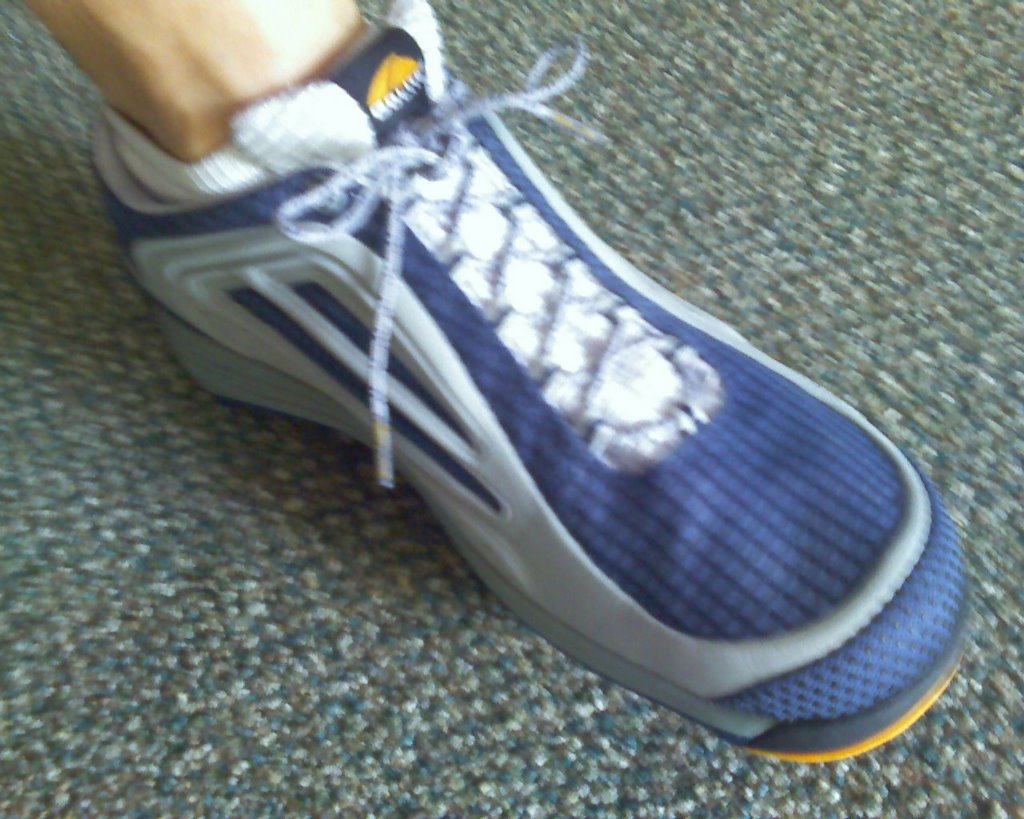
Shoe Search: GoLite Sun Dragon


The GoLite Sun Dragon pictured above is the first of the trail running shoes I've tried on for the CT. There are about half a dozen more I want to try out, all clock in under 24 ounces (680g) per pair.

I will give the Sun Dragons another chance, but my initial impression wasn't favorable. The shoe has a loose fit in the size I need -- there's a lot of movement in the heel cup and for some reason the outside-mid section of my right foot (and not my left) feels funny in the shoe.

They're made for neutral runners and I pronate (roll in) a decent amount.

There's a lot of room in the toe box and the upper is slightly stretchy so it feels good.

The shoes include an interchangeable fore-foot fitting system that I don't know anything about and neither did the salesperson at REI.

I'm unclear as to whether this is a failure to train on the manufacturer's part, or a failure to learn on the retailer's.

In any case, I will try these on again. Demetri is a cool guy, and GoLite is a local (Boulder) company doing a lot of work to lighten peoples' loads.

Wednesday, June 20, 2007

Bars, bars, bars, bars... (Updated - 86 Bars)

For that headline to sound right, you have to sing it like the organ music they play at baseball games.

I am happy to bring food bars along on the trail for the simple facts that they provide tasty mid-day snacking, are ready-to-go, and can be help maintain nutritional balance.

With literally hundreds of bars on the market though, which ones should a backpacker bring?

I'm glad you asked. I've put together a list of bars with basic nutrition information.


Yes, although I wouldn't generally consider them food, I did include Snickers on here. I did so because many backpackers are taking them out and I wanted to show how they compare to other food bars on the market.

Andy Skurka, for example, is taking them I believe and in his blog makes mention that though the candy bars are high in sugar, the high fat content will slow the rate at which they are burned.

I would still consider them luxury items because by and large they are nutritionally bankrupt. The sugar may burn slowler, but your body is going to crash after you process it, and you aren't getting a lot of the vitamins, electrolytes and trace minerals you pick up from the other food bars.

Heat stability is another problem worth considering. If you're hiking in moderate weather with solar exposure, you're likely going to be opening a bag of melted chocolate. If you want a cacao snack, consider taking raw nibs or dark chocolate.

The list is currently at about 7086 bars. I will keep adding more as I have time.

Tuesday, June 19, 2007

Saturday, June 16, 2007

CT Gear List Spreadsheet

This is still incomplete because I still need to acquire my backpack and weigh it. I included a rough estimate of what it should be when I get it. All it takes is some creativity and the will to trust yourself and your equipment to achieve a light weight pack. When the base weight gets below 10 pounds it's all a matter of personal preference of how low you want to go because the fact is that it's really not going to matter on a physical level. However, having that type of mentality is a great asset in backpacking and in life.

Going light makes a world of difference when you're out there on the trail. Not just from a lighter load standpoint, but from the fact that it's a much simpler lifestyle. Mostly everything is a necessity so therefore you frequently use them and some of them have double uses. You become expert in using what you have and you realize that you need nothing more. It's a very liberating way to live knowing how little material one needs. You just have to know how to efficiently use everything you bring with you while not compromising your safety. The resources are out there! This is not about ego, but about being simple.

This philosophy can be transfered over into your daily life which may help reduce the unnecessary stress we have been placing on ourselves and this earth.
-nano

Thursday, June 14, 2007

Some of the best mods are simple

If your gear doesn't meet your needs as packaged: fix it! This is easier for some types of gear, and a sleeping pad is chief among them.

A sleeping pad is intended to provide your bones with some padding for the ground (more important for protecting the hips of scrawny side sleepers like me). Additionally, the sleeping pad insulates you from the ground to varying degrees by type and thickness of pad. If you sleep with your head on a pillow (or pack) and rest your feet on a pillow (or pack), you really only need a pad that reaches from your shoulders to your butt, no wider than your shoulders or hips.

Last year I took a Thermarest Ridgerest (the green one) and was pleased with it. I cut it down and was comfortable when I was carrying it and sleeping on it. This year, I'm trying a closed-cell foam pad (the blue ones they sell at REI). It's a little lighter and I think I'll be comfortable.

As a side note, the Ridgerest is lighter, cheaper and provides more insulation per unit area than the Z-rest which is advertised as packing into a smaller area. Most people pack sleeping pads outside of their pack so I'm not sure why this matters, and once you cut your pad down, it's negligible.

Here's why it's worth cutting your sleeping pad down:

Starting Size: 24.5" x 57"
Starting Weight: 213g (7.5 oz.)

Ending Size: 16.5" x 29"
Ending Weight: 70g (2.5oz.)

Weight Savings: 143g (5 oz.)

Interesting stove information

Temporarily neglecting any concern for authenticity of source, I found this neat article on the temperature of a flame as determined by flame color and distance from the base of the flame.

I'll keep my eye on this since it has some implications in designing (or more precisely, sizing) the pot stand for my stove.